

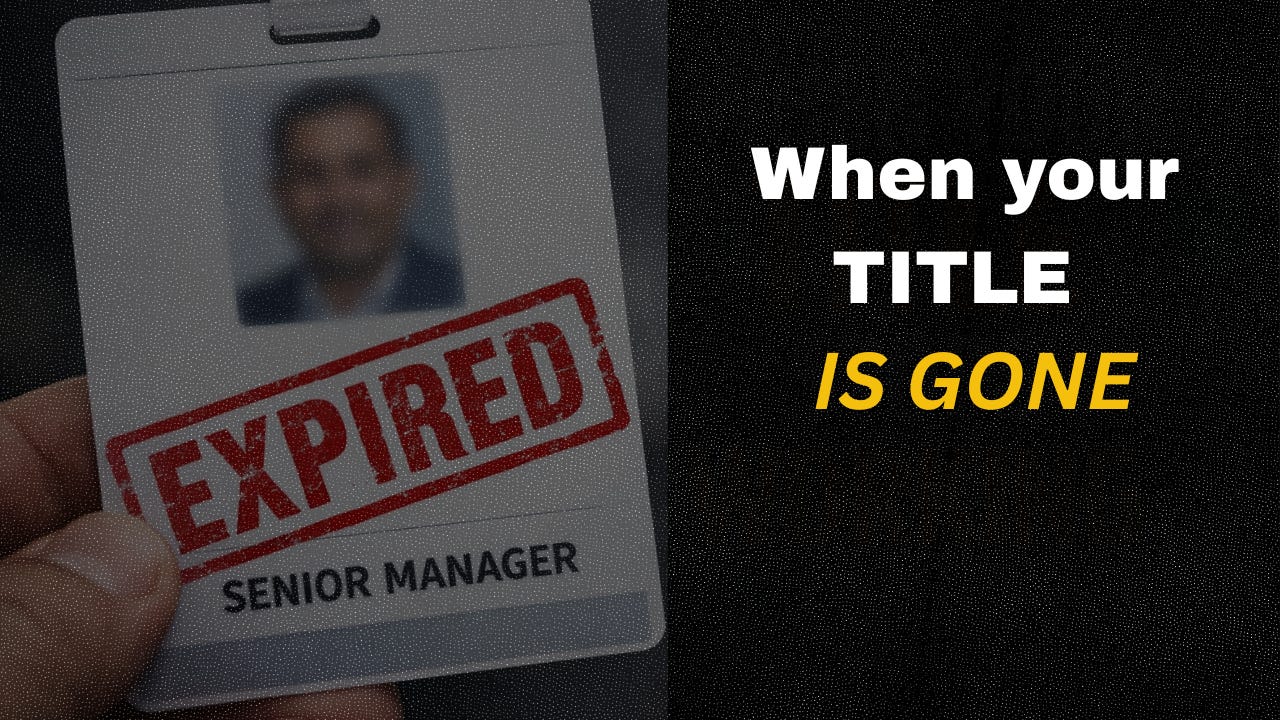
When Your Title is Gone
Will People Still Listen To you?

Prefer to watch this reflection?
Watch the full video here
In corporate life, people listen because your title requires them to.
Remove the title…
Will they still listen ?
For most of my career, I operated inside structure.
I had a title and a designation.
Emails were answered. Meetings were attended. Decisions moved.
I didn’t have to fight for attention — because hierarchy works.
It enforces compliance.
When people respond quickly, you start believing it is because you are persuasive.
When they show up, you assume you are compelling.
When things move, you assume you are inspiring.
Sometimes that is true.
But most times… it is simply structure doing its job.
You don’t notice it till your title is gone.
That’s when the illusion comes crumbling down.
And you realise the humbling truth
Position is not influence.
A senior leader in my organisation once told me,
“If you want to understand real leadership, try becoming the secretary of your building society.”
This is immediately relatable.
Its one of the toughest job there is !
Why ?
Nobody reports to you.
Nobody cares about your designation.
If still people are listening, that’s because they truly respect you .
Writing is a bit like that
There was no title attached to my words.
No reporting line.
No organisational chart.
No requirement to engage.
If someone read what I wrote, it was voluntary.
If they ignored it, nothing happened.
It was humbling and provided me a major lesson in leadership
Titles can demand attention.
Influence must earn it.
I started writing as a means to process huge changes that were taking place in my life.
I was going through stuff and it was hard.
I was becoming aware of my own mortality.
Writing was cathartic and a way for me to process these changes
Private writing is messy but safe . You can contradict yourself , go ballistic with words
A no holds barred cleansing.
Then I pressed “Publish”
And things changed after that .
Not because people rushed to applaud me
But now the book was public and I was accountable for what I had written
Private writing is reflection.
Public writing is exposure.
You feel vulnerable and naked under the glare.
remember the first comment I received.
A colleague said,
“I read The Interview. It wasn’t a real interview.”
He sounded disappointed.
And I felt it immediately.
The urge to knock some sense into him.
To explain what the story really meant.
The symbolism behind it.
To defend the choice.
To defend the craft.
Inside corporate life, if someone misunderstands you, you clarify.
You explain.
You push.
You don’t stop until everyone is aligned.
Outside the corporate structure
The reader has the right to interpret.
And the right to reject.
You are not entitled to being understood.
A title can demand compliance.
But when the title fades — as it eventually will —
what remains is whether anyone chooses to listen anyway.
That’s when you understand there are two kinds of influence.
One is inherited through position.
The other is granted through trust.
The first comes with hierarchy.
The second comes with honesty.
In corporate life, your voice is amplified by designation.
Outside it, your voice stands alone.
And perhaps that is the real test.
Not whether people are required to listen —
but whether they choose to.
And when that happens, you discover where you truly stand.
You discover whether what you built was structural…
or personal.
Writing did not make me influential.
It simply revealed what remained when the title was removed.
What remained was me.
This is Venkatachalam Viswanathan
Author of Nine Lives
If you would like to read or see more of such content, consider Subscribing. Its free.